


Beyond Vertical and Reverse Mentoring
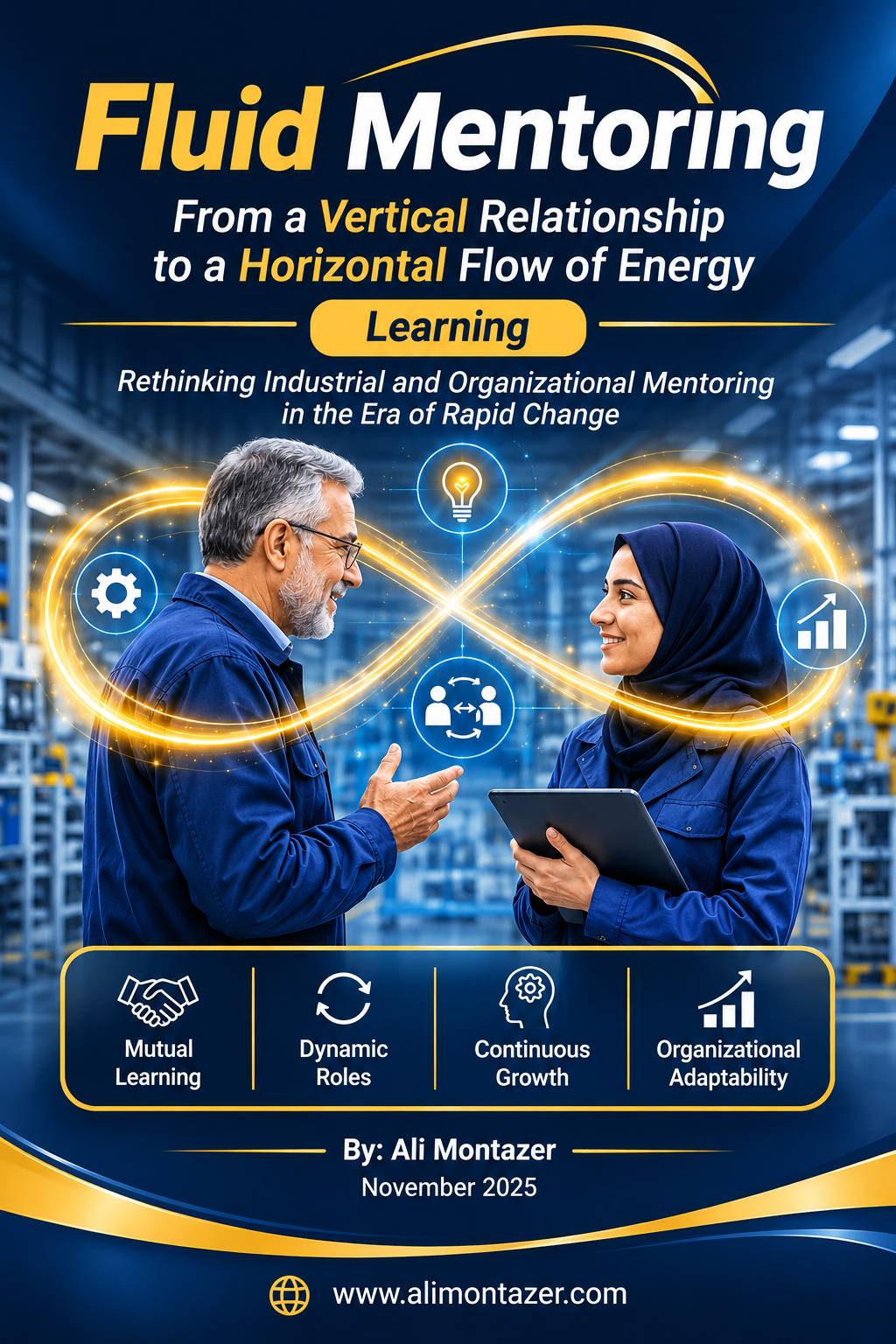
Fluid Mentoring as a Dynamic, Reciprocal Flow of Learning Energy in Industrial and Organizational Life
A research-informed perspective on industrial mentoring, reciprocal learning, and organizational adaptability
Author: alimontazerolzohour
November 2026
Abstract
Organizations have traditionally treated mentoring as a relationship in which a more experienced person guides a less experienced colleague. Reverse mentoring challenged this hierarchy by recognizing that younger or less senior employees may teach executives about digital technologies, emerging markets, and changing social expectations. Both models have value, yet both can preserve the same underlying architecture: one person is designated as the source of learning and another as its recipient. This article proposes a broader approach: fluid mentoring. In fluid mentoring, mentor and mentee are not permanent identities but temporary roles that shift according to the problem, the knowledge required, and the experience available in a particular moment. Learning moves horizontally and reciprocally across age, rank, function, and professional background. Its core is not the transfer of information alone, but a living exchange of energy expressed through questions, practice, feedback, reflection, and changed behavior. Experience remains important, but it is not a sealed asset; its value depends on its relevance to current conditions. The article develops this proposition through an industrial story, a conceptual framework, practical design principles, and implementation actions. It argues that organizations should move from mentoring as a fixed program to mentoring as an everyday capability of a learning system.
1. The workshop where the hierarchy stopped helping
At the beginning of a morning shift in a manufacturing plant, a production line began to lose rhythm. The experienced maintenance supervisor, Reza, had spent twenty-five years learning the sounds, smells, and small movements of the machines. He could often diagnose a fault before an alarm appeared. Beside him stood Sara, a recently recruited automation engineer, who understood the plant's new sensor network, data dashboards, and predictive maintenance software. Reza knew the machine's history; Sara could read patterns across thousands of operating records. At first, each waited for the other to lead. Reza assumed that experience should decide. Sara assumed that the digital system should provide the answer. The fault continued.
Then something changed. Reza asked Sara to show him what the sensor trend was revealing. Sara asked Reza what had changed in the machine's sound during the last hour. They compared the dashboard with the physical behavior of the equipment. The data suggested a bearing issue, but Reza recognized that the vibration pattern was unusual for that failure. Together they discovered a misalignment introduced during a recent component replacement. Sara helped translate the observation into a measurable signal; Reza helped interpret the signal in the context of the machine's operating history. Neither simply taught the other. Each became a learner and a contributor.
The episode was not a formal mentoring session. It was a small act of reciprocal learning under operational pressure. Yet it illustrates a central proposition: in a complex industrial environment, the most useful person to learn from is not always the person with the highest title, the longest service, or the newest technical knowledge. It is the person who can help the team see what the current problem requires. At one moment Reza was mentor; at another, Sara was. Their roles changed without ceremony because the work demanded it.
2. The limits of a one-way model
Traditional mentoring has made an important contribution to professional development. A more experienced colleague can help another person understand organizational culture, navigate difficult decisions, develop judgment, build networks, and avoid preventable mistakes. Formal mentoring can make tacit knowledge visible and can give less experienced employees access to support that would otherwise be unevenly distributed. The problem is not the existence of senior-to-junior mentoring. The problem begins when it becomes the dominant or exclusive picture of how learning should happen.
A fixed hierarchy can create several unintended effects. The mentor may feel pressure to appear knowledgeable even when the situation is unfamiliar. The mentee may become dependent on advice rather than developing the confidence to investigate and decide. Knowledge may travel in only one direction, while valuable insights held by frontline workers, new employees, specialists, contractors, and younger colleagues remain unheard. A mentoring relationship can then reproduce organizational status rather than challenge it.
In industrial settings, this limitation is especially visible. A senior engineer may understand design intent and historical failure modes, while an operator may know how a process behaves during night shifts, under variable raw-material quality, or when production pressure rises. A data analyst may see a trend that neither has noticed. A safety professional may identify a risk that is invisible within the production team's habitual routines. No single role contains the whole truth of a complex system.
The aim, therefore, is not to abolish seniority or disregard experience. It is to stop confusing seniority with universal expertise. Authority can be relevant to accountability, but it should not automatically determine who has the most useful knowledge in every learning situation. Mentoring becomes more powerful when expertise is recognized as distributed, contextual, and sometimes temporary.
3. Reverse mentoring: a necessary correction, not the final destination
Reverse mentoring is often associated with arrangements in which younger or less senior employees mentor older or more senior colleagues. It became prominent as organizations sought to help leaders understand digital technologies, new communication practices, social media, emerging consumer expectations, and the perspectives of younger generations. Wendy Marcinkus Murphy's work on reverse mentoring describes its potential for cross-generational learning and for developing the leadership capabilities of the younger mentors. The model makes a valuable statement: insight does not flow only from the top of an organizational chart.
However, reverse mentoring can retain the same vertical logic with the arrow simply turned in the opposite direction. A junior employee is assigned the role of teacher; a senior executive is assigned the role of learner. This is useful when the learning objective is specific, but it does not necessarily create a culture in which roles can change continuously. It may also stereotype people by age: younger colleagues are presumed to understand technology, while older colleagues are presumed to possess wisdom or institutional knowledge. In reality, neither assumption is universally true.
Reverse mentoring is best understood as one important practice within a larger ecology of learning. It corrects a blind spot in traditional mentoring, but fluid mentoring asks a further question: why should the direction of learning be fixed at all? A senior leader may teach a new colleague how to interpret a complex stakeholder environment, then learn from that colleague how an emerging AI tool changes the workflow. A production operator may mentor a software developer about the realities of the shop floor, then learn from the developer how to use a new interface. The direction changes with the issue, not with the age or rank of the participants.
4. The central proposition: fluid mentoring
Fluid mentoring is a reciprocal and context-sensitive developmental relationship in which people move between mentor and mentee roles according to the knowledge, skill, attitude, and perspective required by a changing situation. It is horizontal in its learning logic, even when participants occupy different formal positions. Horizontal does not mean that organizational hierarchy disappears, that accountability becomes unclear, or that every opinion has equal technical validity. It means that rank alone does not decide who is allowed to contribute, question, teach, or learn.
The term fluid is deliberate. A fluid system adapts its movement to changing conditions. In fluid mentoring, the relationship is not defined permanently by who gives and who receives. The roles can change within a single conversation, across a project, or over the course of a career. A maintenance expert may guide a young engineer through a failure analysis in the morning and ask that engineer to explain a new diagnostic model in the afternoon. A plant manager may coach a supervisor on stakeholder communication while learning from the same supervisor how a new shift pattern affects fatigue and safety.
Fluidity also describes the content of experience. Experience is not a static treasure that retains equal value forever. It is a resource that must be interpreted, tested, updated, and sometimes unlearned. A procedure that was effective under one production technology may become inefficient or unsafe after automation, regulation, customer requirements, or material characteristics change. The value of experience lies not simply in having lived through an event, but in the ability to extract a useful lesson and adapt it to present conditions.
This does not mean that every new idea is superior to established practice. Experience can reveal hidden constraints and prevent fashionable but impractical solutions. The point is to put experience into dialogue with current evidence. In a learning organization, experience is neither worshipped nor discarded. It is continuously revalidated.
5. Learning energy: the engine of the relationship
The distinctive language of this proposal is the flow of learning energy between people. Energy here is a conceptual metaphor, not a claim about a measurable physical substance. It describes the vitality that emerges when curiosity, attention, trust, challenge, practice, and feedback circulate between participants. A mentoring conversation can contain a great deal of information and still produce little learning if one person dominates, the other remains passive, or neither is willing to test assumptions. Conversely, a short exchange can generate substantial learning when it changes what people notice and do.
Learning energy is visible in questions that open rather than close thought; in the willingness to admit uncertainty; in the courage to challenge a familiar explanation; in the generosity to share practical knowledge; and in the discipline to turn insight into action. It is strengthened when participants feel respected and safe enough to speak honestly. Amy Edmondson's research on psychological safety and team learning found an association between psychological safety and learning behavior in work teams. The implication for mentoring is practical: people must be able to ask, disagree, report mistakes, and expose gaps in understanding without fear of humiliation.
Energy also needs direction. A friendly conversation is not automatically a developmental relationship. It must connect to a real question, a meaningful challenge, or a capability that matters. It should result in some combination of new understanding, improved skill, changed attitude, better coordination, or a more reliable decision. In this sense, fluid mentoring is not endless conversation; it is purposeful exchange.
The flow can be imagined as a cycle: a challenge creates a question; the question brings different experiences into contact; dialogue produces a hypothesis; practice tests the hypothesis; feedback refines it; reflection turns the episode into transferable learning. The cycle then begins again with a new challenge. The relationship remains alive because learning is not completed once and for all.
6. What actually flows? Knowledge, skill, and attitude
The content of fluid mentoring can be understood through three connected dimensions: knowledge, skill, and attitude. Knowledge includes concepts, facts, technical principles, regulations, data, and an understanding of why a process works. It matters, but in many operational contexts knowledge alone is insufficient. A person may know the correct procedure and still be unable to perform it under pressure.
Skill is the capacity to apply knowledge in action. It includes technical execution, diagnosis, communication, listening, problem-solving, digital fluency, coordination, and the ability to make sound judgments in real conditions. In industrial environments, skill is often demonstrated through timing, sequence, feel, pattern recognition, and disciplined execution. Some of it is explicit and can be documented; some is tacit and is learned through observation, guided practice, and feedback.
Attitude shapes how knowledge and skill are used. Curiosity, accountability, humility, openness to evidence, respect for safety, willingness to collaborate, and readiness to revise an assumption all influence whether learning becomes possible. A technically capable employee who refuses feedback can obstruct improvement. A curious employee who lacks the necessary technical foundation may generate ideas that cannot be safely implemented. Strong mentoring therefore connects all three dimensions.
In many workplace situations, skill and attitude may carry greater practical weight than the accumulation of additional information, especially when people already have access to extensive technical documentation and digital tools. Yet knowledge remains essential as the foundation and the seasoning: it helps people understand the principles behind action and avoid repeating errors. The balance varies by task. A safety-critical procedure may demand precise knowledge and certification; a cross-functional innovation challenge may depend heavily on curiosity, collaboration, and experimentation. Fluid mentoring does not impose one universal ratio. It asks what combination is required here and now.
7. Experience is valuable, but its value is contextual
One of the most important implications of fluid mentoring is a different understanding of experience. Experience is often treated as a stock: the more years someone has worked, the more valuable their contribution is assumed to be. Years can matter, but duration alone is a weak proxy for current relevance. Repetition may deepen expertise, or it may reinforce an outdated mental model. A person can have thirty years of learning, or one year of learning repeated thirty times.
Experience becomes valuable when it is converted into judgment. That conversion requires reflection: What happened? Why did it happen? Which conditions made the response effective? What has changed since then? What should be retained, adapted, or abandoned? This is why a veteran employee's story is most useful when it is examined rather than simply admired. The lesson should be separated from the circumstances that produced it.
The same principle applies to newer experience. Familiarity with a new platform does not automatically confer deep understanding of the process into which it is introduced. A young specialist may know how a tool works but not understand the consequences of a false alarm, a delayed intervention, or a poorly designed handover. The experienced operator may know those consequences but lack the technical vocabulary to interpret the new system. Each has partial knowledge. The quality of learning depends on bringing those partial views together.
A useful question for every mentoring exchange is therefore not, “Who has more experience?” but, “Which experience is relevant to this situation, and what evidence would show that it still applies?” This question respects the past without allowing it to govern the future unquestioned.
8. Why industrial organizations need this model
Industrial organizations operate through interdependent systems: people, machines, materials, information, standards, customers, suppliers, and regulations. Change in one part can affect the whole. Digitalization, automation, artificial intelligence, energy transition, supply-chain volatility, demographic change, and new expectations around safety and sustainability increase the need for learning across boundaries. No single department can hold all the knowledge required to respond.
Fluid mentoring can connect generations without reducing people to generational stereotypes. It can connect engineering and operations, maintenance and production, quality and procurement, safety and human resources, headquarters and the frontline. It can make tacit knowledge more accessible while allowing new technical practices to be challenged against operational reality. It can also reduce the distance between formal expertise and practical intelligence.
Consider a recurring quality defect. A conventional response may assign a senior quality specialist to train operators. A reverse mentoring response might ask operators to explain a new digital inspection tool to the quality manager. A fluid mentoring response creates a joint inquiry. Operators describe the conditions under which the defect appears; quality specialists explain the measurement system; maintenance checks equipment variation; procurement investigates material differences; data analysts explore patterns across shifts. Participants teach and learn in multiple directions. The output is not merely a trained individual but a stronger collective capacity to diagnose and prevent the defect.
This model is especially relevant where safety and reliability are critical. It must never weaken formal authority, competency requirements, or stop-work rights. Rather, it should make it easier for anyone with relevant information to speak up, while ensuring that decisions remain accountable and are made by appropriately qualified people. Horizontal learning and clear operational governance are complementary, not contradictory.
9. From mentoring pairs to a learning network
A mentoring program built only around fixed pairs can be valuable, but it may not be sufficient for complex organizational challenges. Fluid mentoring suggests a network model. People connect around questions, projects, incidents, skills, and emerging technologies. A person may be a mentor in one network and a mentee in another. The network can include peers, specialists, supervisors, apprentices, external partners, and communities of practice.
The network should not become an unstructured marketplace in which everyone is expected to teach everything. It needs a clear purpose, boundaries, and coordination. Participants should know what they are trying to learn, what knowledge is sensitive, which tasks require certified competence, and who is accountable for final decisions. The role of leaders is to create the conditions for exchange: time, access, trust, facilitation, recognition, and opportunities to apply learning.
A useful design principle is to organize around work rather than status. Instead of asking, “Which senior manager will mentor this employee?”, ask, “What challenge are we trying to solve, and whose perspectives are needed?” Instead of selecting mentors only by tenure, identify people who have relevant expertise, practical credibility, willingness to share, and capacity to learn. The best mentor for a particular question may be a frontline operator, a data scientist, a project manager, a customer-facing colleague, or a new employee who sees an assumption that insiders have stopped noticing.
The network also supports continuity. When one person leaves, learning need not disappear with them if insights have been captured in after-action reviews, demonstrations, process notes, and communities of practice. Documentation does not replace human exchange, but it helps the organization retain what the exchange produces.
10. The conditions that make fluid mentoring work
First, psychological safety must be real rather than rhetorical. Leaders should respond constructively when people raise concerns, ask basic questions, or admit that they do not know. This does not mean avoiding accountability. It means separating honest learning behavior from negligence or deliberate misconduct. A team cannot learn from signals that people are afraid to report.
Second, participants need mutual respect. Senior employees should not be treated as obstacles to change, and younger employees should not be treated as inexperienced by definition. Respect is not agreement; it is the willingness to examine another person's evidence and reasoning. Third, the relationship needs a shared purpose. A specific operational challenge, development goal, or capability provides focus and prevents the exchange from becoming vague.
Fourth, the organization must make time for learning. If production targets consume every available minute, mentoring becomes an additional burden and is likely to be abandoned. Learning should be integrated into shift handovers, problem-solving meetings, maintenance reviews, project retrospectives, and improvement routines. Fifth, leaders should model the behavior. When a manager publicly asks a junior colleague to explain a new tool, acknowledges a mistake, or changes a decision after hearing frontline evidence, the organization sees that learning is not a loss of status.
Finally, learning must be applied. Participants should have opportunities to test new methods within appropriate controls, observe results, and refine their approach. Without application, the energy of the relationship dissipates. Without reflection, the experience may not become transferable knowledge. Without follow-up, the organization cannot tell whether the exchange made a difference.
11. Three practical action initiatives
Action 1 — Launch a 90-day Fluid Mentoring Pilot. Select one operational challenge with visible business relevance, such as recurring downtime, quality variation, onboarding, digital adoption, or handover reliability. Form small cross-functional learning groups rather than assigning only senior-to-junior pairs. Each group should include people with different forms of relevant experience. At the first meeting, agree on the challenge, boundaries, learning goals, and a simple baseline measure. Rotate the role of facilitator and invite participants to identify when they are teaching and when they are learning. At day 30, review what has been tested; at day 60, adjust; at day 90, document outcomes and decide whether to scale. Success should be measured through both learning indicators and operational outcomes.
Action 2 — Introduce the “Two-Way Shift Handover.” Once a week, pair a person with deep process experience and a colleague with a different technical, functional, or generational perspective for a structured 20-minute exchange. Each person answers two questions: “What do I know that may help you?” and “What might I be missing that you can help me see?” End with one practical test, one risk to watch, and one lesson to share with the next shift. This action turns the ordinary handover into a small learning loop. It is deliberately simple, so it can be embedded in existing routines rather than creating a new bureaucracy.
Action 3 — Build a Living Experience and Skills Map. Map critical capabilities, not just job titles or years of service. Identify who understands particular equipment, customer situations, data tools, safety risks, regulatory requirements, and problem-solving methods. Record where knowledge is concentrated in one person and where a capability is vulnerable to turnover. Add a mechanism for employees to update the map as they learn new skills. Use it to create temporary learning connections around real work. Protect personal data and avoid turning the map into a ranking or surveillance tool. Its purpose is to make expertise discoverable and learning more accessible.
Action 4 — Hold Monthly Learning Exchanges. Invite employees from different levels and functions to present one case: a failure, an improvement, a customer insight, a near miss, or a successful experiment. The presenter should explain what was expected, what actually happened, what was learned, and what should be tested next. The session should include questions from people who approach the issue differently. Leaders should attend as learners, not only evaluators. Capture the transferable lesson and the conditions under which it applies.
Action 5 — Reward Learning Behavior, Not Only the Expert Identity. Recognize employees who share knowledge, ask useful questions, invite challenge, help colleagues practice, and revise their own assumptions when evidence changes. Avoid rewarding only the person who appears to have the answer. A culture that celebrates being right more than becoming better will discourage the humility required for fluid mentoring.
12. How to measure whether the flow is working
Fluid mentoring should be evaluated with a balanced set of indicators. Participation counts alone are insufficient: a program can hold many meetings without producing meaningful learning. At the individual level, assess whether participants report greater confidence in asking questions, giving and receiving feedback, applying new skills, and seeking expertise beyond their immediate team. Use short reflection prompts before and after a pilot, and where possible observe behavior rather than relying only on self-report.
At the team level, examine the frequency and quality of cross-functional problem-solving, the speed with which issues are escalated, the extent to which lessons from incidents are shared, and whether people from different roles contribute to decisions. At the operational level, choose measures appropriate to the challenge: downtime, repeat defects, rework, onboarding time, near-miss reporting quality, process adherence, customer complaints, or time to competence. Do not claim that mentoring alone caused every improvement; operational outcomes have multiple influences. Instead, use the measures to test whether the learning intervention plausibly contributed.
A useful evaluation asks four questions. Did people learn something they did not know before? Did they develop the ability or confidence to do something differently? Did the team change a routine, decision, or interaction? Did that change improve a relevant outcome without creating unacceptable risks elsewhere? The fourth question is particularly important in industrial environments, where local efficiency can sometimes undermine system reliability or safety.
Qualitative evidence matters too. Collect short stories of role reversal: a supervisor who learned from an operator, an apprentice who helped a veteran interpret a digital signal, or an engineer who changed a design after observing actual work. These stories reveal whether the culture is changing, while quantitative indicators help test whether the change has practical value.
13. Risks, boundaries, and common misunderstandings
Fluid mentoring can be misunderstood as an argument that experience no longer matters, that all knowledge is equal, or that hierarchy should be removed. None of these claims is intended. Some decisions require formal authority, professional certification, legal accountability, or specialist competence. A new employee cannot safely mentor an experienced technician in a regulated task merely because the relationship is reciprocal. The relevant expertise must be demonstrated, and learning must occur within safety and governance requirements.
Another risk is role confusion. If people do not know who is responsible for a decision, collaboration can become indecision. The solution is to distinguish learning roles from decision rights. People may contribute to learning in multiple directions while the organization retains clear accountability for approvals, technical standards, and operational control.
There is also a risk of performative reciprocity: leaders announce that everyone can teach everyone, but dismiss contributions that challenge established assumptions. This creates cynicism. The response must be visible behavior: leaders should ask, listen, test, and explain when a suggestion is not adopted. Equally, participants should learn to challenge respectfully and support claims with evidence.
Finally, fluid mentoring should not become another unpaid expectation placed on already overloaded employees. Organizations should recognize mentoring time, develop facilitation skills, protect confidentiality, and provide support when sensitive interpersonal or performance issues arise. It is a developmental practice, not a substitute for supervision, formal training, professional coaching, or sound workforce planning.
14. The leadership shift: from possessing answers to enabling exchange
The leader in a fluid mentoring culture does not need to be the person who knows everything. The leader must be capable of creating the conditions in which the right knowledge can emerge, be tested, and be used. This requires a shift from the image of the leader as the source of answers to the leader as designer of learning conditions. The leader asks better questions, connects people who would not otherwise meet, makes time for reflection, and protects constructive dissent.
This is not a retreat from leadership. It is a more demanding form of leadership. It requires confidence without arrogance, authority without defensiveness, and the ability to distinguish a challenge to an idea from a challenge to a person's dignity. It also requires judgment: not every suggestion is sound, not every experiment is safe, and not every disagreement needs to become a committee. The leader's task is to keep the learning process open while ensuring that action remains disciplined.
In this sense, fluid mentoring is closely related to the idea of a learning organization. It turns learning from an event scheduled by human resources into a capability embedded in everyday work. It connects individual development to operational performance and makes knowledge sharing part of how the organization adapts. Mentoring is no longer something that happens only when a designated mentor meets a designated mentee. It happens whenever people deliberately exchange perspectives to improve their understanding and action.
15. Conclusion: from fixed roles to a living current
The question is not whether traditional mentoring or reverse mentoring is better. Both can be useful, and both respond to genuine developmental needs. The deeper question is whether organizations can move beyond the assumption that learning must have a fixed direction. In a world where technologies, markets, regulations, work practices, and expectations change continuously, the source of useful insight also changes. A person may be an expert in one context and a beginner in another. A veteran may hold indispensable knowledge and still need to unlearn a familiar routine. A newcomer may bring a fresh perspective and still need the judgment that comes from practice.
Fluid mentoring offers a way to understand this reality. It treats mentoring as a dynamic, horizontal, reciprocal process in which people move between teaching and learning according to the demands of the moment. Its essential movement is a flow of learning energy: curiosity meets experience, knowledge meets skill, attitude shapes action, feedback refines judgment, and practice turns insight into capability. Experience is not discarded; it is made current through dialogue and application.
The industrial story at the beginning offers a simple image. The machine did not care who had the longest tenure or the newest title. It required people to combine what they knew, question what they assumed, and act together. Reza and Sara were not successful because one became the mentor and the other the mentee. They were successful because they allowed those roles to move.
Perhaps the future of mentoring is not a ladder with an arrow pointing up or down. It is a current: moving, adapting, returning, and carrying useful knowledge wherever it is needed. Organizations that learn to create this current will not merely transfer experience. They will renew it. They will not only develop individuals. They will strengthen their collective ability to notice, adapt, and improve.
The final proposition is therefore straightforward: stop asking who the mentor is and who the mentee is. Ask what the situation requires, who can contribute, what each person needs to learn, and how the exchange can be converted into better action. When people become both learners and teachers—without being trapped in either identity—mentoring becomes not a hierarchy, but a living organizational capability.
Fluid_Mentoring_Article.pdf
References
Allen, T. D., Eby, L. T., O’Brien, K. E., Lentz, E., & Lima, L. (2008). The state of mentoring research: A qualitative review of current research methods and future research implications. Journal of Vocational Behavior, 73(3), 343–357. https://doi.org/10.1016/j.jvb.2007.08.004
Bokeno, R. M., & Gantt, V. W. (2000). Dialogic mentoring: Core relationships for organizational learning. Management Communication Quarterly, 14(2). https://doi.org/10.1177/0893318900142002
CIPD. (2025, August 11). Coaching and mentoring. https://prod.cipd.org/uk/knowledge/factsheets/coaching-mentoring-factsheet/
Edmondson, A. (1999). Psychological safety and learning behavior in work teams. Administrative Science Quarterly, 44(2), 350–383. https://doi.org/10.2307/2666999
Eby, L. T., & Robertson, M. M. (2020). The psychology of workplace mentoring relationships. Annual Review of Organizational Psychology and Organizational Behavior, 7, 75–100. https://doi.org/10.1146/annurev-orgpsych-012119-044924
Lankau, M. J., & Scandura, T. A. (2002). An investigation of personal learning in mentoring relationships: Content, antecedents, and consequences. Academy of Management Journal, 45(4), 779–790. https://doi.org/10.2307/3069311
Marcinkus Murphy, W. (2012). Reverse mentoring at work: Fostering cross-generational learning and developing millennial leaders. Human Resource Management, 51(4), 549–573. https://doi.org/10.1002/hrm.21489
Ragins, B. R. (2012). Relational mentoring: A positive approach to mentoring at work. In K. S. Cameron & G. M. Spreitzer (Eds.), The Oxford Handbook of Positive Organizational Scholarship (pp. 520–536). Oxford University Press. https://doi.org/10.1093/oxfordhb/9780199734610.013.0039
Ropes, D. (2019). Reverse mentoring: A review of extant literature and recent trends. Development and Learning in Organizations. https://doi.org/10.1108/DLO-05-2019-0103
Senge, P. M. (1990). The fifth discipline: The art and practice of the learning organization. Doubleday.